

Automation in intralogistics has advanced rapidly. More and more companies are turning to driverless transport systems and autonomous mobile robots to make processes more flexible, faster, and more cost-effective. But while fleet management, navigation, and software interfaces have long been part of strategic planning, one aspect is surprisingly often left to chance: the power supply.

“The fragmentation of the charging infrastructure is a relic from a time when FTS projects were viewed as isolated islands. Today, as companies seek to network and scale their fleets, this approach has become a bottleneck.”
Anyone walking through an automobile factory or a large distribution center today will often find an ad-hoc structure: here, an AGV project for supplying the assembly line; there, one for incoming goods; and a third for order picking. Each of these projects was planned, put out to bid, and implemented individually—often by different manufacturers. The result: Each AGV provider brought its own charging technology, determined the locations of charging points on its own, and registered its own rated connection capacities with the utility provider. What began as a pragmatic solution has now become a cost driver. In the worst-case scenario, five different AGV projects mean five separate charging infrastructures with five times the installation costs. Matthieu Ebert, Director of Product at Wiferion, describes this as an outdated relic.
Other industries are leading the way
Interestingly, neighboring industries have already solved this problem. In the field of electric mobility, it was clear from the start: An electric car must be able to charge at any charging station, not just manufacturer-specific ones. Harmonizing the charging infrastructure was not an option, but a prerequisite for market success. Even the forklift industry established a standardized manual charging connector early on with the Rema plug.
Only the AGV industry is clinging to the lock-in effect—for now. Because the pressure is mounting. The VDA 5050 initiative shows where things are headed: operators no longer want to be forced to use five manufacturers with five fleet managers for five processes. The harmonization of core value creation—vehicle control and fleet management—is in full swing. The next logical step is the power supply.
The Underestimated Savings Potential: Rated Power and Floor Space
Operators who take control of their own charging infrastructure can reap significant economic benefits. The most important one: reducing the rated power of the grid connection. In the traditional “island” approach, each FTS project registers its own rated power, which is designed for the theoretical maximum scenario where all vehicles are charging simultaneously at full power.

Ownership is transferred to the operator
The key question is: Who actually determines where charging points are located and which technology is used? Historically, this decision rested with the AGV manufacturer. But that is currently changing fundamentally. The operator has long held indirect responsibility for the charging points. This is because the operator defines the transfer stations, the stopping points, and the process workflows. This automatically determines the pool of possible charging locations. With in-process charging—charging during process stops that occur anyway—this connection becomes particularly clear. In large greenfield projects, operators today take a more holistic approach. If a centralized fleet manager is already in use, why shouldn’t the charging infrastructure also be planned uniformly? Instead of procuring four proprietary charging systems from four AGV manufacturers, a harmonized infrastructure can supply all vehicles. With the Praxis
“We’re seeing that more and more large projects are already being put out to bid with the requirement to use a specific charging technology,” reports Ebert. “The decision is no longer made by the AGV manufacturer—it comes from the end customer.”
Why Wireless Charging Is the Logical Solution
In theory, a standardized connector could also be the solution to one of the most pressing problems in mobile robotics. In practice, however, this is not feasible due to physical constraints: Different vehicle heights, designs, and docking positions make a universal mechanical connection nearly impossible.
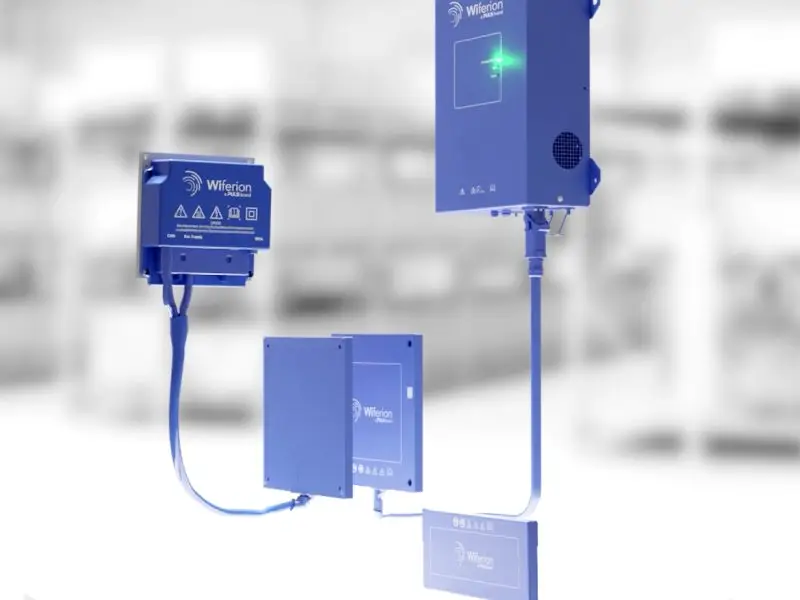
Contactless inductive charging, on the other hand, offers precisely the flexibility required by a multi-manufacturer infrastructure. The positioning tolerances are high enough to accommodate various vehicle types. There are no mechanical wear parts, no contact issues, and no maintenance requirements. Wiferion will demonstrate how such a scalable energy architecture can be implemented in practice at LogiMAT. There, the company will present new solutions that take this development into account—and help operators realize the described cost-saving potential in concrete terms.
Conclusion: Charging Infrastructure as a Strategic Priority
The days when the power supply for AGV fleets was treated as a mere technical detail are over. Anyone investing in automation today should treat the charging infrastructure as an architectural consideration from the very beginning, rather than as an afterthought to the purchase of robots. Operators who embrace this paradigm shift reap multiple benefits: They reduce costs associated with grid connection, installation, and space requirements. They gain flexibility in choosing their AGV manufacturers. And they create an infrastructure that grows with their needs—from the first pilot installation to a fully automated factory.
“The question is no longer whether harmonization is coming,” summarizes Matthieu Ebert. “The question is how quickly it will happen, which AGV operators will see it as an opportunity, and which AGV manufacturers will view the interoperability requirement as an opportunity rather than a threat.”